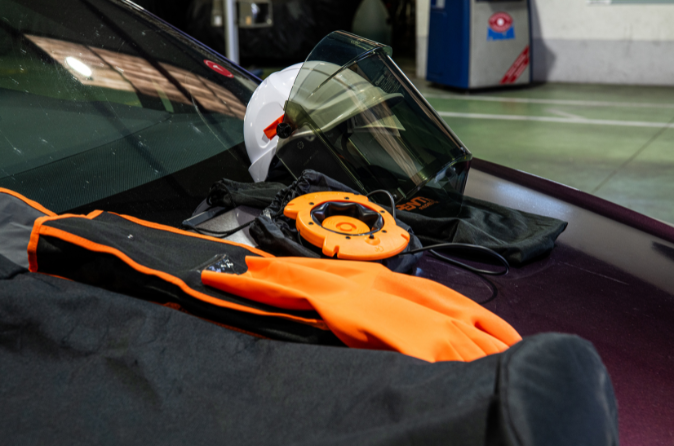
When working on electrified vehicles, the reliability of PPE is non-negotiable. Insulating gloves, helmet, face shield, arc-flash clothing… each piece of equipment must be fully operational when needed. This is where two concepts that are often confused come into play : the periodic inspection and the pre-use check. They do not involve the same people, do not take place at the same time, and do not cover the same scope. Understanding the difference means eliminating blind spots in the protection of your teams.
The periodic inspection : a company responsibility
The periodic inspection is a formal, planned process that falls under the responsibility of the employer. It applies to all Category 3 PPE ( https://www.economie.gouv.fr/dgccrf/les-fiches-pratiques/equipement-de-protection-individuelle) — those that protect against fatal or irreversible risks — and must be entrusted to a designated person who has been specifically trained to carry it out.
For insulating gloves (Class 00 and 0, standard EN 60903), after the first year, this inspection is mandatory every 6 months following commissioning. It combines an inflation test carried out using a pressurisation device that checks the entire glove, and a thorough visual inspection. The rolling method must be excluded as it does not allow the entire surface to be inspected. A positive result must be recorded in a register. Any defective glove must be immediately discarded, without exception.
For helmets, face shields, and arc-flash clothing, the standard does not impose a formalised periodic inspection. This absence of a regulatory frequency does not mean they are exempt from monitoring — on the contrary, it reinforces the importance of the pre-use check.
The pre-use check : operator vigilance
The pre-use check is carried out by the operator themselves, before each intervention. It is a professional act in its own right, as important as checking one's tools before starting work.
For insulating gloves, the protocol is identical to that of the periodic inspection : a pressurisation device covering the entire glove, combined with a thorough visual inspection. A glove that does not hold pressure, or that shows discolouration, a cut, or deformation, must be immediately set aside.
For helmets and face shields, the check involves verifying the absence of scratches or cracks on the visor, the integrity of the fixings, and the overall condition of the helmet. A scratch on the visor affects the UV protection integrated into the material — in such cases, the visor must never be used.
For arc-flash clothing, the operator inspects the seams, fastenings, and overall condition of the fabric. Particular attention is paid to stains, marks, and areas of wear that may indicate a degradation in protective performance.
What changes depending on the PPE : a clear summary
Insulating gloves are the only PPE for which both checks are mandatory and formalised : the periodic inspection every 6 months by a designated person, and the pre-use check by the operator before each use. They are also the only PPE whose commissioning depends on the date of manufacture — more than one year after manufacture, first use requires a prior periodic inspection.
For helmets, the situation is different : no mandatory periodic inspection, but a 5-year limit from the date of manufacture, after which the helmet must be discarded without exception. The pre-use check therefore becomes the only safety net between interventions.
For clothing, there is neither a commissioning deadline nor a regulatory periodic inspection — but a maximum number of washes to be tracked, and a visual pre-use check that remains the only guarantee of an intact level of protection.
Key takeaways
The periodic inspection structures the management of the PPE inventory over time. The pre-use check ensures that the equipment is fit to protect here and now. One does not replace the other : together, they form a complete monitoring system.
At PENTA, we support professionals in the electrified mobility sector in implementing these protocols. Because the safety of your teams starts with PPE that is checked, not just worn.



 Main menu