Reliability is no accident
Category 3 PPE protects against fatal risks or irreversible damage (electrical shocks, arc-flash, working at height). Faced with these extreme dangers, wearing the equipment is not enough: its performance depends directly on the care it receives. A poorly maintained PPE is a flaw in your safety. Maintenance, inspection, and storage are therefore not mere recommendations, but important daily steps.
Rigorous inspection: the "zero doubt" rule
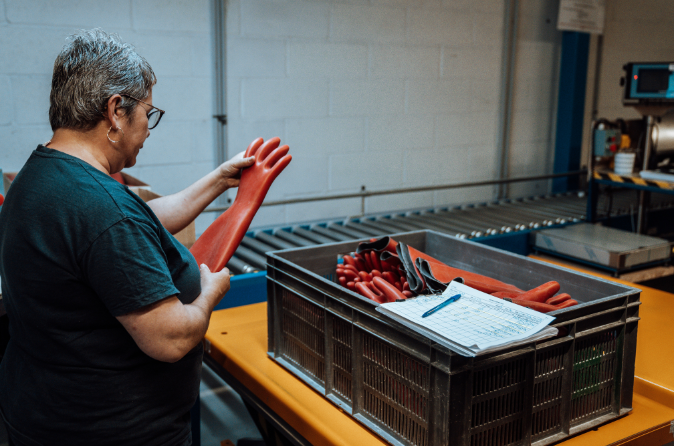
Before each intervention, a visual inspection is essential. For an insulating glove, this involves an inflation test to detect the slightest micro-leak. For a face shield, it means the absence of scratches. For technical clothing, you must look out for failing seams or tears.
Special attention must be paid to soiling: a transformer oil stain or a battery acid splash alters the fiber and can compromise protection against an electrical arc. The garment must then be removed and washed immediately.
An excellent practice is to check your equipment at the end of the working day, to identify any problems before the next intervention.
In the event of an anomaly, the rule is absolute: if there is any doubt, the PPE is discarded. No concessions are allowed when it comes to safety.
Storage: the invisible enemy of PPE
The worst enemies of your protective equipment are often the environment and negligence. A helmet left on the parcel shelf of a vehicle in direct sunlight will suffer the attacks of UV rays and heat, degrading its shock absorption capacity. Insulating gloves thrown loosely into a box among metal tools risk being punctured at any moment.
To preserve the integrity of the materials, it is imperative to store PPE away from light, moisture, extreme temperatures, and dust.
The use of covers or storage bags (often supplied with the equipment) is an integral part of PPE protection and will contribute to improving its lifespan.
Cleaning and lifespan: the user manual is the ultimate guide
Each piece of equipment meets performance requirements dictated by the standards and the materials used. While a helmet has a defined period of use (often 5 years from commissioning, unless extended by an expert), multi-risk clothing is managed by the number of wash cycles (washing + drying).
Whether the fabric is inherently flame retardant (FR) or has received a specific treatment, an unsuitable washing or drying temperature can destroy its properties. All the answers (maintenance methods, maximum number of cycles, optimal conditions) can be found in the user manual and/or on the label. This is the only reliable reference.
What to remember
The lifespan and effectiveness of Category 3 protective equipment rely on the care provided by its user.
It is to help our network of professionals adopt these best practices that the team at PENTA Electrical Safety Products provides clear and detailed instructions with every PPE. Because optimal protection in the field requires equipment that is cared for daily.



 Main menu